When I look at my kindergarten graduation photos, the first thing I notice is that almost nothing fit me properly.
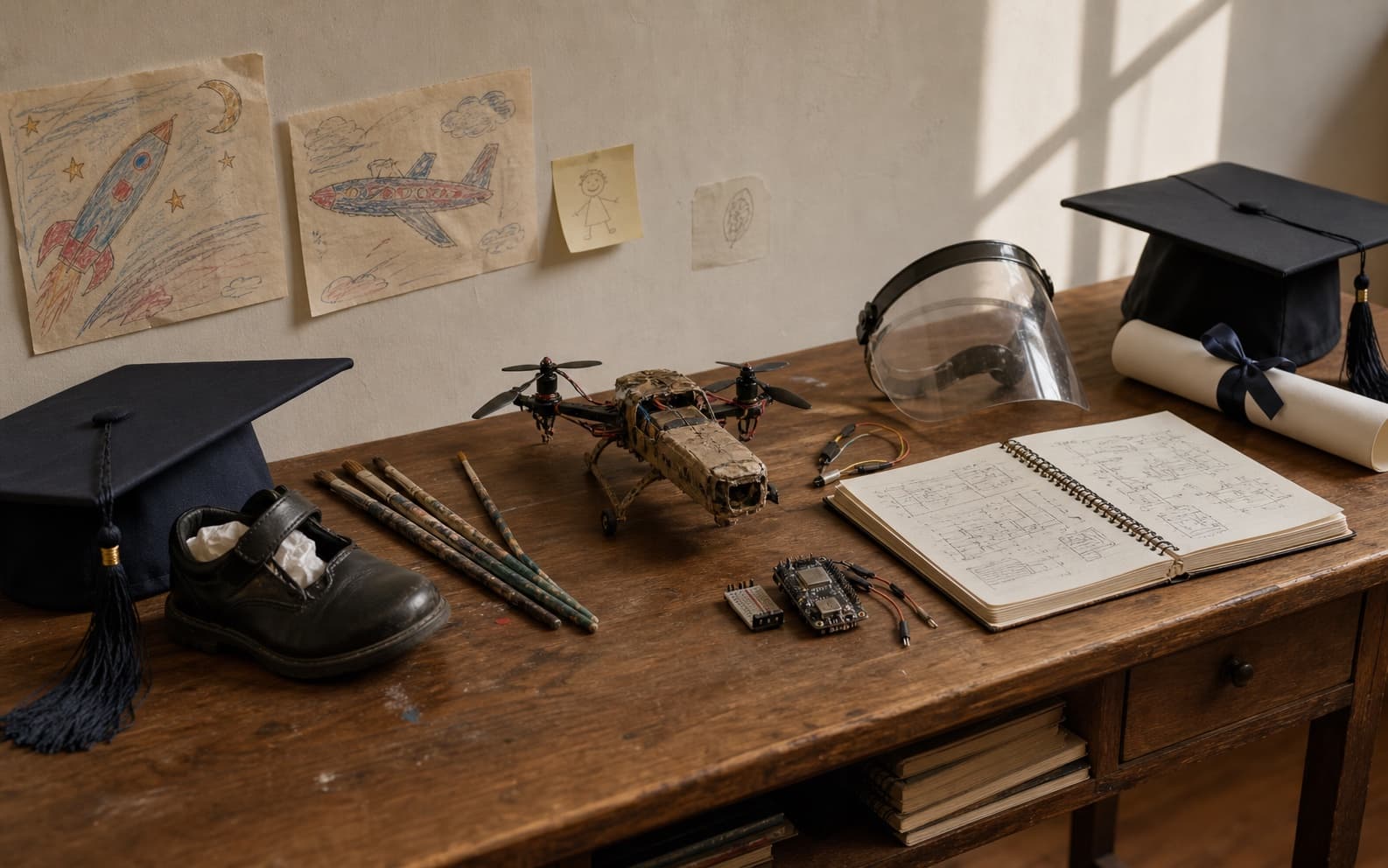
My uniform was oversized because I was told I could still use it when I grew bigger. My shoes had tissue stuffed inside so my feet would fit. Even my graduation cap looked bigger than my head.
I also remember already having a career plan. I wanted to become a doctor and help treat sick people, and at that age the plan really was that simple: become a doctor, help people, done.
If only I had known how complicated that dream was.
That was the first of several futures I imagined for myself. I didn't grow up knowing I would become an engineer. The direction changed many times, usually because of whatever I was interested in (or confused by) at that point in my life.
Elementary school — the future businessman
In elementary school, I got into art. I joined poster-making contests, won some of them, and enjoyed turning ideas into drawings and designs.
My dream career had nothing to do with art, though. I wanted to become a businessman.
My reasoning was simple: businessmen had a lot of money, so becoming one would let me give my family a better life. As far as I understood it, starting a business meant becoming rich automatically.
Young me had everything figured out.
The reason behind the dream was sincere, even if my understanding of business was a little incomplete. I wanted to provide for my family. I just had no idea what that would take.
Junior high — art, architecture, and getting excused from class
My interest in art grew in junior high. I joined the Visual Arts Club and started thinking architecture might be the right path for me.
I liked painting and making things with my hands. I was always happy when we were asked to paint stage decorations, because it meant being excused from regular classes. Sometimes I even got out of MAPEH.
It felt like the perfect arrangement: I got to paint, and I got to skip class for it.
Architecture seemed to connect creativity with practical work, so for a while that was the future I pictured.
Then Grade 10 gave me a project that failed.
Grade 10 — the drone that became an airplane
For one of our science projects, my group decided to build a DIY drone.
It sounded like a great idea. The only problem was that I barely knew anything about Arduino, electronics, programming, flight control, or most of the other things a drone needs to fly.
Unsurprisingly, it didn't work.
We ended up turning what was supposed to be a working drone into a model of an old airplane. Thankfully, the airplane model was accepted.
While trying to build it, though, I got curious about how code, electronics, and hardware could work together. That curiosity was one of the reasons I chose the STEM strand for senior high school.
There was one small problem: I wasn't particularly good at Math.
I chose STEM anyway.
Lakas tama.
Senior high — the Smart Face Shield
In senior high, I was part of a group called the Invectors. For our research project, we built a Smart Face Shield.
For a long time, I wasn't sure the thing would work. We experimented, failed, changed parts of the system, and tried again.
Eventually, it worked.
What started as a requirement we had to submit went on to win several competitions. The recognition was exciting, but what stayed with me was how much I enjoyed the work itself. I liked building systems, especially ones where hardware and software had to be figured out together through trial and error.
I'm especially thankful to the teacher who guided us through it. By the end of that project, engineering was what I wanted to pursue.
College — engineering became real
I entered Laguna State Polytechnic University to study Computer Engineering and found myself in a very different environment, with harder subjects, constant deadlines, sleepless nights, and plenty of moments when I questioned myself. Engineering was no longer one successful school project. I had to work through it every week.
When I started college, I had a specific goal: graduate with Latin honors and make my parents proud.
My first-year grades were good, so the goal seemed realistic. Then engineering humbled me.
Second year was harder. The subjects got more complicated, and eventually I received a 2.50, which made me ineligible for Latin honors.
I was disappointed. Not devastated, but definitely disappointed.
After a while, I started paying more attention to the skills I enjoyed developing: programming, software development, robotics, electronics, and building apps and websites that worked outside a classroom explanation.
I put more effort into those and, admittedly, a little less into the subjects I didn't enjoy as much.
Whenever a subject involved an app, a website, a robot, or some hardware, I wanted to do my best. Those were the moments that reminded me why I had chosen Computer Engineering.
Thesis — building without a roadmap
I went into our thesis with another ambitious goal. I wanted to build something I could be proud of, hopefully one of the best projects we could make.
Instead, we chose a topic that was probably far more complicated than it needed to be.
There was no YouTube tutorial showing the whole process, no blog post explaining the entire system, and no existing project we could copy as a reference. We were figuring out the architecture while trying to make it work, without being sure the final system would work at all.
In the end, it did. Not perfectly, but it worked, and getting it to that point was already a huge achievement for us.
For around six months, I kept coming back to the same device. I worked on the wiring and component placement, the ESP32 firmware, the frontend and backend, the communication between hardware and software, and the countless small problems that showed up during integration.
We also went through revision after revision, on both the device and the thesis paper. There were many days when I was tired of looking at it and trying to understand why one more thing wasn't behaving the way we expected.
My thesis groupmates helped me keep my sanity. All three of them had their own kind of saltik.
The work was stressful, but we also laughed a lot. I'm grateful to them and to our friends from Studie Shesh for supporting us throughout.
At some point, my thesis ambition got much simpler. I stopped worrying about making the perfect project.
The new goal was:
Survive. Finish what I started. Graduate.
Eventually, I did.
Graduation — I finally made it
After all those years, I graduated with a Bachelor of Science in Computer Engineering.
The path makes more sense now than it ever did while I was on it. The kid in the oversized uniform wanted to be a doctor, then a businessman, then an architect. A failed drone got me curious about technology, and the Smart Face Shield turned that curiosity into a direction. College cost me the Latin honors I wanted and gave me a thesis we had to build without a roadmap.
I changed my mind a lot and failed at a few things along the way, and I kept building anyway.